GBIF Alert watches the world's largest network of biodiversity records and emails you the moment new occurrences of your target species appear in your region. Your species. Your area. The moment they show up.
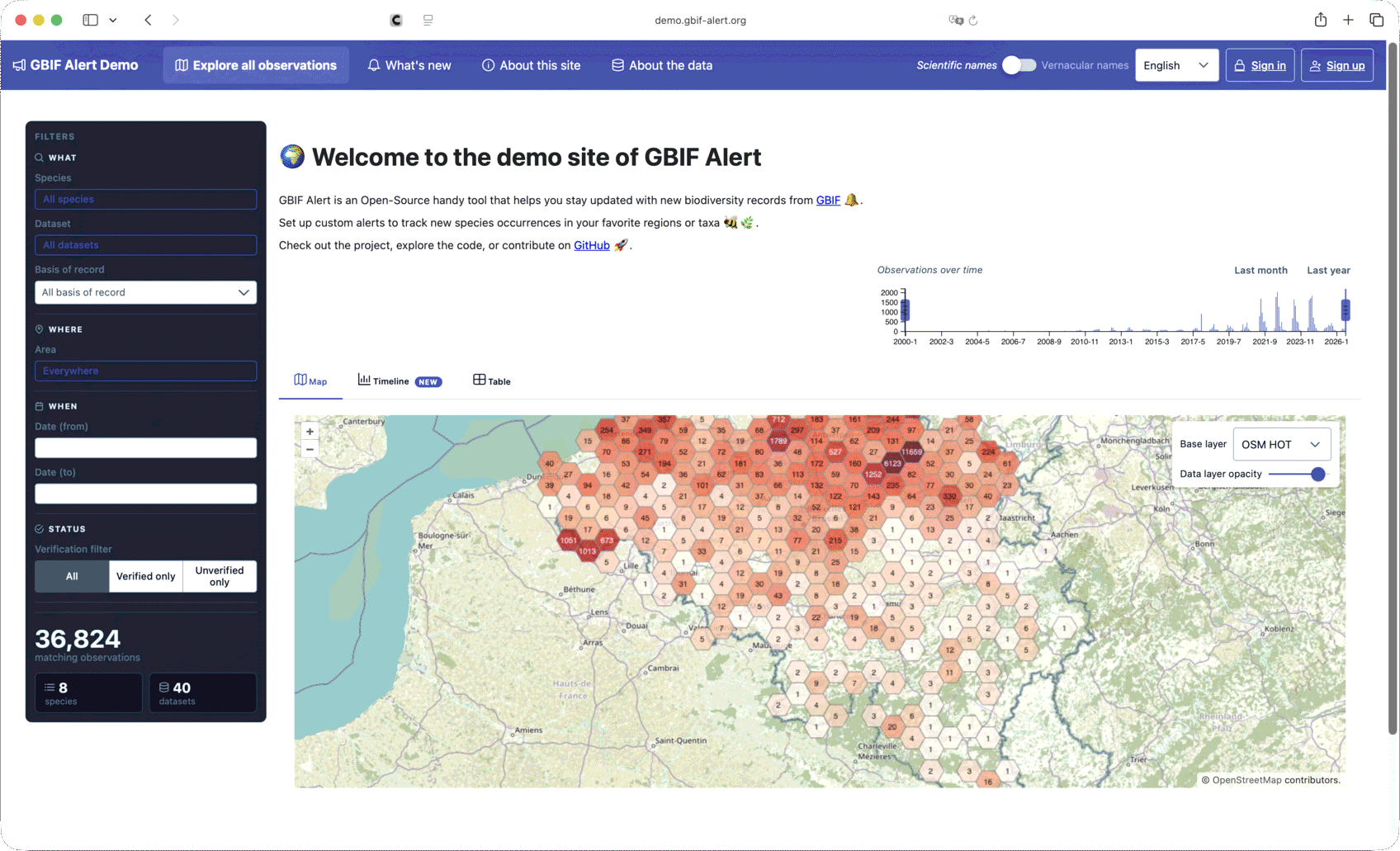
Knowing when a species appears — exactly where and when it matters — can be the difference between timely action and a missed opportunity.
GBIF Alert is an open-source early-warning system that continuously monitors the GBIF network and notifies you by email as soon as new occurrences of your chosen species are recorded in your area of interest — whatever you need to track. No scraping, no manual checks, no licensing fees.
Because it runs entirely on open data (everything comes from GBIF) and is itself fully open source under the MIT license, any institution can deploy its own instance, tailor it to its mandate, and trust both the data and the code behind every alert. It's already running in production for LIFE RIPARIAS and powering the Belgian Biodiversity Platform — and it's free for any organisation to adopt.
GBIF Alert can watch any taxa in any area — each operator decides what their instance is about. It grew out of invasive-species early warning, but the same engine serves a much wider range of needs.
"If it's in GBIF and you can draw a boundary around it, GBIF Alert can watch it for you."
Open all the way down — from the data it watches to the code that runs it.
Every alert is powered by GBIF, the global reference network for biodiversity occurrence data. No proprietary feeds, full traceability back to the source records.
Released under the permissive MIT license. Inspect it, fork it, adapt it to your needs — with no per-seat or per-alert cost and no vendor lock-in.
Run it entirely yourself, or get professional help with installation, hosting, customisation and maintenance — directly from The Binary Forest, the developers of GBIF Alert, not a third-party reseller. You choose your level of involvement.
Ships with Docker and docker-compose configurations, so a technical team can stand up a fully working instance quickly — on your own servers or in the cloud.
A documented public HTTP API (v2) plus an OGC WFS service let you plug GBIF Alert data straight into your dashboards, GIS tools and reporting pipelines.
Cut through the noise: filter by species, date and data quality — for example only validated observations — and by fine-grained areas, including records approaching a zone of interest. Alerts stay relevant and actionable.
Institutions curate the data that matters; their communities subscribe to exactly what they need.
As the institution, you set up an instance: a dedicated website tailored to a specific community. You define the slice of GBIF that matters — your target species and your geographic area — give it your branding, and run it for your audience. One instance, one focused mission.
The people your community serves register on your instance and set up their own alerts within that scope: which species, which sub-areas, and how often they're notified. You set the playing field; they set their own game.
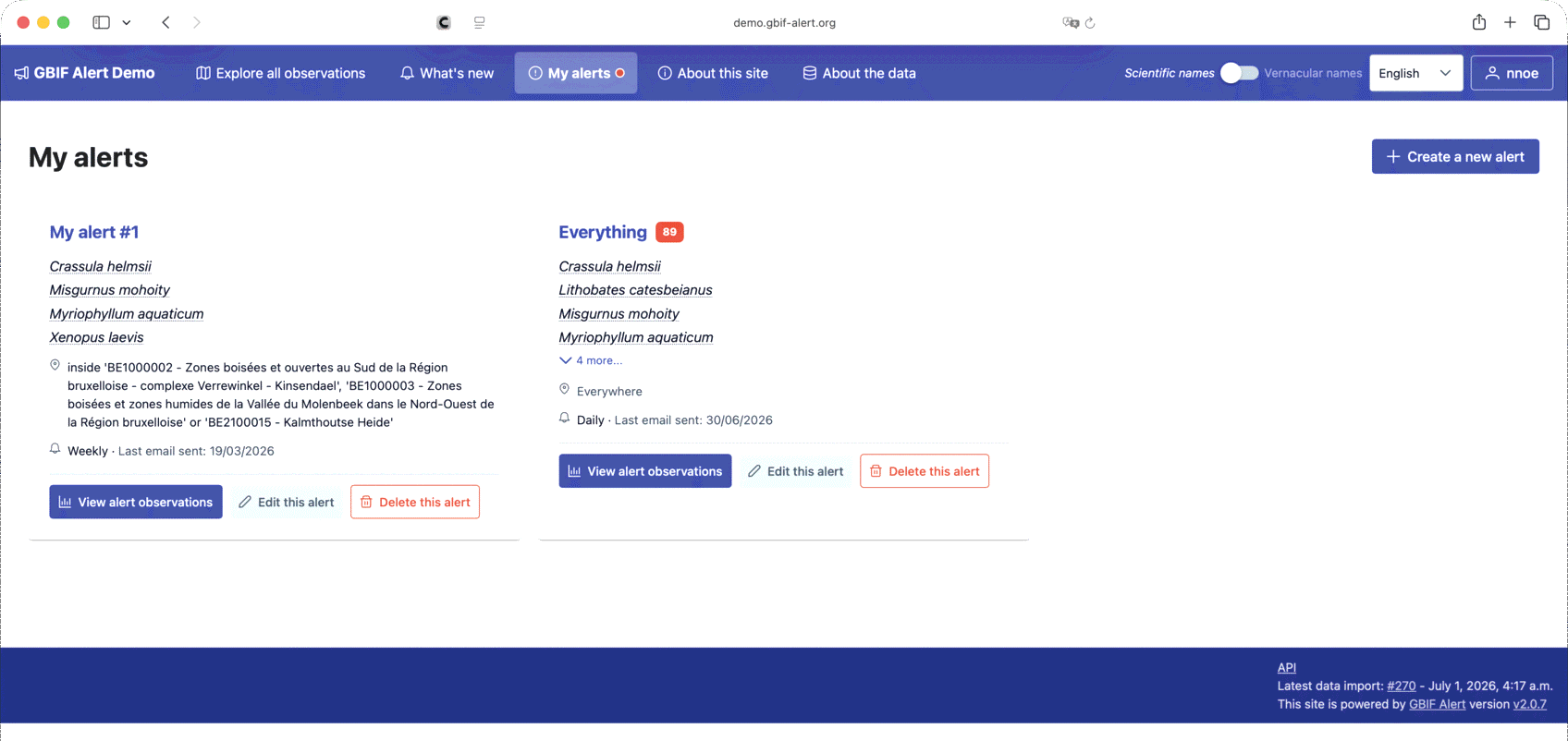
The subscriber experience: configure your alerts, then let matching records come to you by email.

Set up personal alerts — species, areas and how often you're notified.

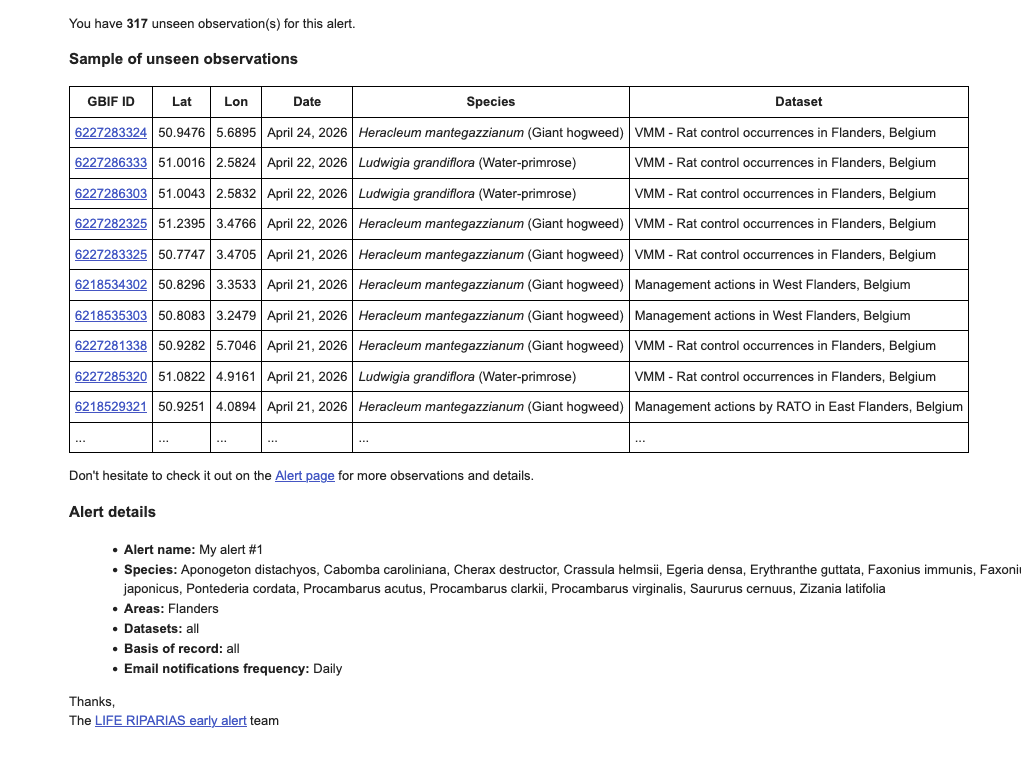
A notification email — sent the moment new records match.
Are you interested in records for an area and species already covered? Register on an existing instance and start configuring your alerts in minutes.
Try the demo →Want full control over species, region and branding for your community? GBIF Alert is fully configurable and easy to install with Docker.
Read the install guide →
Development of GBIF Alert has been supported by the European Union's Horizon Europe research and innovation programme under grant agreements No 101181413 (GuardIAS) and No 101180559 (OneSTOP), and previously by LIFE RIPARIAS.
Funded by the European Union. Views and opinions expressed are however those of the author(s) only and do not necessarily reflect those of the European Union or the European Research Executive Agency (REA). Neither the European Union nor the granting authority can be held responsible for them.